


By Alyssa Hughes
Thailand has always been known for its tourism & agricultural industries in addition to its prominence as a manufacturing hub. There may, however, be another opportunity that has yet to be considered, becoming a base for professional services that supports businesses both in Thailand and overseas.
With more international companies setting up operations within Thailand alongside the wider ASEAN region, demand for professional services such as accounting, tax, legal and business advisory may subsequently rise. In Thailand, it is particularly important to have local support because certain official documents and administrative processes must be conducted in the Thai language. At the same time, Thai firms could explore opportunities to provide such services to clients in other markets, through cross border support and outsourcing of accounting services in Thailand or also other consulting support.
Thailand’s Opportunity
Recent investment data shows an encouraging starting point. According to the ASEAN Investment data in 2025, Foreign Direct Investment (FDI) into ASEAN attracted US$243.9 billion that year, 9.7% higher than 2024. Consequently, this outlines a trend of increasing appeal in the ASEAN markets. Thailand recorded one of the fastest growth rates in the region, with FDI inflows rising by 30.3%, reaching US$19.1 billion, suggesting growing investor interest in the Kingdom.
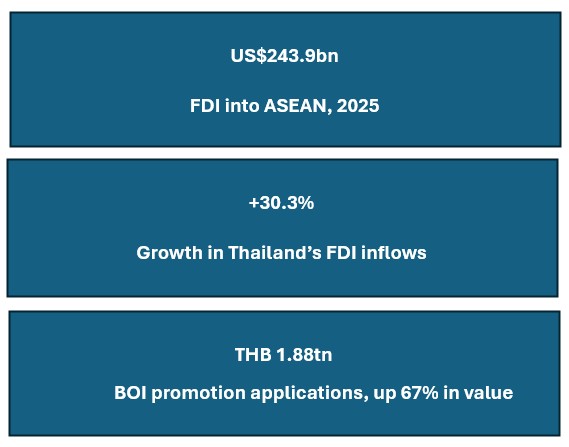
Although these figures do not directly measure professional services investment, international businesses establishing or expanding their operations in Thailand may create a derived demand for services such as accounting, tax, legal and business advisory support, thus this could be viewed as an opportunity for Thailand to develop this sector alongside the wider economy.
Thailand’s advantages
- Location and Connectivity: Thailand’s position within ASEAN provides direct access to neighbouring markets and opportunities to support businesses operating across the region. Moreover, good transport infrastructure and digital connectivity within the country, may also support business operations and regional coordination.
- Local Talent: Thailand has an existing base of local professionals familiar with the variety of Thai regulations, tax requirements, and business practices, all of which are valuable knowledge for businesses entering the Thai market.
- BOI incentives: For eligible projects, the Board of Investment offers incentives such as corporate income tax exemptions and import duty exemptions on machinery (subject to conditions). Whilst this does not directly increase Thailand’s competitiveness in professional services, it can instead support eligible business investment which can contribute to the environment in which those services can grow.
- Cost competitiveness: Lower operating and labour costs are important for businesses deciding where to locate. Thai-based firms could also take advantage of these lower costs by offering bookkeeping, accounting support, and other business administration services overseas, for instance to the United Kingdom. However, costs alone may not be enough. Firms still need the right expertise, effective communication skills, and ability to meet international standards. Particularly as higher value services may offer only minimal cost savings if outsourced to Thailand.
- Industrial base: Often referred to as the “Detroit of the East,” Thailand has a strong automotive industry and network of manufacturers and suppliers, which in turn create demand for support from professional services firms, presenting an opportunity for the sector to develop alongside the industrial sector.
The Challenges Thailand Faces
- English proficiency: Thailand’s English proficiency is not as developed compared to certain other ASEAN countries and therefore, could make some service roles difficult to compete with, particularly those involving regular communication with overseas or foreign clients. As a result, improving their English-speaking capabilities could assist Thai firms to work more effectively with international businesses.
- Skilled Labour: Professional services require experienced staff who understand client needs and potentially work across languages, standards, and regulatory systems. According to The Global Talent Competitiveness Index in 2025 Thailand ranked 77th from 135 countries, whereas Singapore was first. Despite the index not measuring every aspect of workforce ability, it highlights the importance of developing and retaining skilled workers, especially if Thailand wants to expand into more specialised services.
- Regulation: Businesses entering Thailand may face complicated visa and work permit requirements, as well as restrictions under the Foreign Business Act. Certain restricted activities limit foreign ownership to 49% unless an exemption applies. Some companies will also need to employ 4 Thai nationals per foreign employee, depending on the applicable rules. Language barriers add to these challenges as many official legal documents and communications with government officials are conducted in Thai, only further emphasising the need for local assistance.
It is crucial to note that technology has proved to be an effective solution in addressing some of these issues. AI tools can be used to assist with tasks, translations, and efficiency. However, in the professional services industry, human expertise is essential for the utmost accuracy and compliance.
Competition Regionally and Internationally
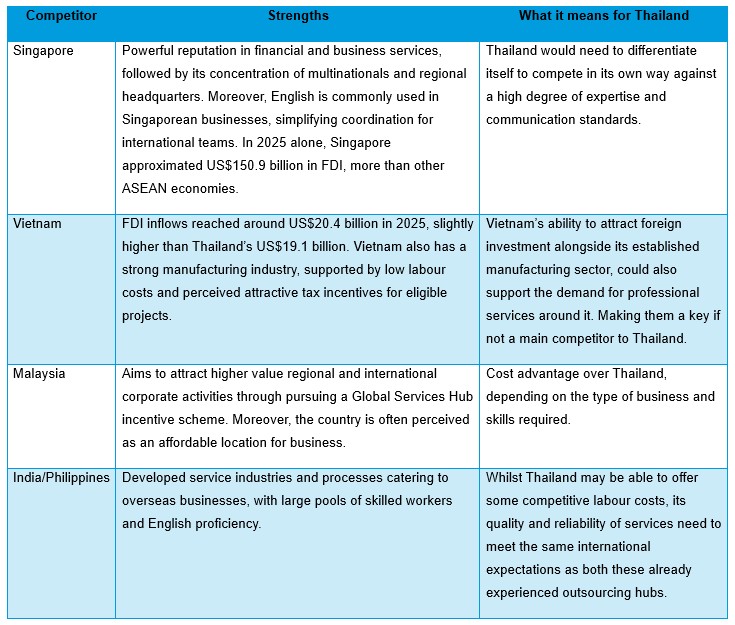
Thailand may not have the same international networks Singapore’s has or the scale of India’s outsourcing industry. However, they could identify specific services where it has relevant competitive expertise, rather than attempting to compete across every individual professional service category.
What Does This Mean for Businesses?
Entering Thailand
Businesses entering Thailand will need to understand how business works in Thailand to ensure they are compliant and can manage their operations effectively. Local professionals are essential in navigating this process.
Thai Businesses Supporting a Wider Market
Firms with the right proficiency and capabilities could explore opportunities to support clients across ASEAN and/or provide services for more distant markets. However, competing internationally means Thai firms must be able to communicate, meet client expectations reliably and deliver to the right standard.
Summary
Thailand has an opportunity to strengthen its role in professional services supported by increasing investment and a strong industrial base. However, with more established competitors in the region and internationally, cost, and incentive advantages alone will not be enough. Whether Thailand can make the most of this opportunity and create a larger industry for the economy depends on how they tackle ways to improve their English language capabilities, develop the skills needed for more specialised services whilst maintaining high standards doing so.
How Can RSM Thailand Assist?
For companies entering Thailand or developing their existing operations, accurate and reliable professional advice can make all the difference in decision-making.
RSM Thailand offers a one-stop shop, providing expertise in a broad range of professional services including Accounting, Tax Services, Business Advisory and Legal Corporate Advisory, Audit and Assurance, and Recruitment Services.
Should you require any advice with respect to this article or any of our Audit, Accounting, Payroll, Taxation, Legal or Recruitment and Outplacement Service, please do not hesitate to contact us on Askus@rsmthailand.com